How to avoid AI slop: what actually separates forgettable AI content from content that works
AI slop isn't about using AI. It's about skipping the process steps that prevent it. Here's what actually separates content that reads as AI from content that doesn't.


"AI slop" was Merriam-Webster's 2025 word of the year. Most content marketers already knew what it meant before the dictionary caught up.
You've read it. Posts that open with "In today's digital landscape…" Articles that lead with a rhetorical question and spend 800 words rephrasing the same three sentences. LinkedIn carousels that feel generated at 2am and published at 6am without anyone looking at them first. The pattern registers in two seconds, and your readers register it just as fast.
The uncomfortable part: 94% of B2B marketers plan to use AI for content in 2026, and non-AI blog creation has dropped from 65% to 5% in two years. Most people are using AI for content now. The question is not whether you use it. It's whether your output reads like you do.
What AI slop actually is, and what it isn't
The brands that have taken real reputational hits for AI content (Coca-Cola, Svedka, H&M, among others) were not penalised for using AI. They were penalised for making the AI visible. Openly AI-branded campaigns. Output so generic it was indistinguishable from model defaults. That is a different failure from using AI for a draft.
Gen Z in particular is turning away from content that reads as AI-authored rather than AI-assisted. The backlash is specifically against visible AI output and against brands that appear not to have read their own content before publishing it. The reader's calibration is: did a person engage with this?
81% of B2B marketers use generative AI tools. Only 19% have integrated AI into a daily workflow with consistent process steps and quality gates. Most teams own the tools. Fewer own the sequence. And when you work from a disconnected stack rather than a documented workflow, the model default is what ships.
That's what AI slop is. Not AI-assisted content. Model-default output, published without the steps that would have made it sound like a person wrote it.
The engagement and trust data behind the backlash
The consumer signals are specific. A 2025 study found 59% of people trust online content less than they used to, and 78% say it's now harder to distinguish AI-written content from human-written content. These numbers do not mean people prefer human writing in the abstract. They mean readers have calibrated to recognise certain patterns, and when they detect them, trust drops.
Unreviewed AI output measurably degrades engagement. When AI-only drafts are published without an editorial pass, bounce rates go up and time-on-page comes down. The mechanism is direct: generic output doesn't deliver what a specific headline promised. The reader arrives, scans, finds nothing particular, and leaves.
The "soulless AI content" objection is partly right. Generic AI output does exist, it does damage real engagement, and a workflow has to prevent it. The objection just misnames the cause. The variable is not AI use. It's the missing review step. Teams that publish from model directly to page get the generic output; teams that publish from model through a brand voice profile and editorial pass get content that performs. That distinction is where this piece is headed.
Where the failure happens: the missing editorial step
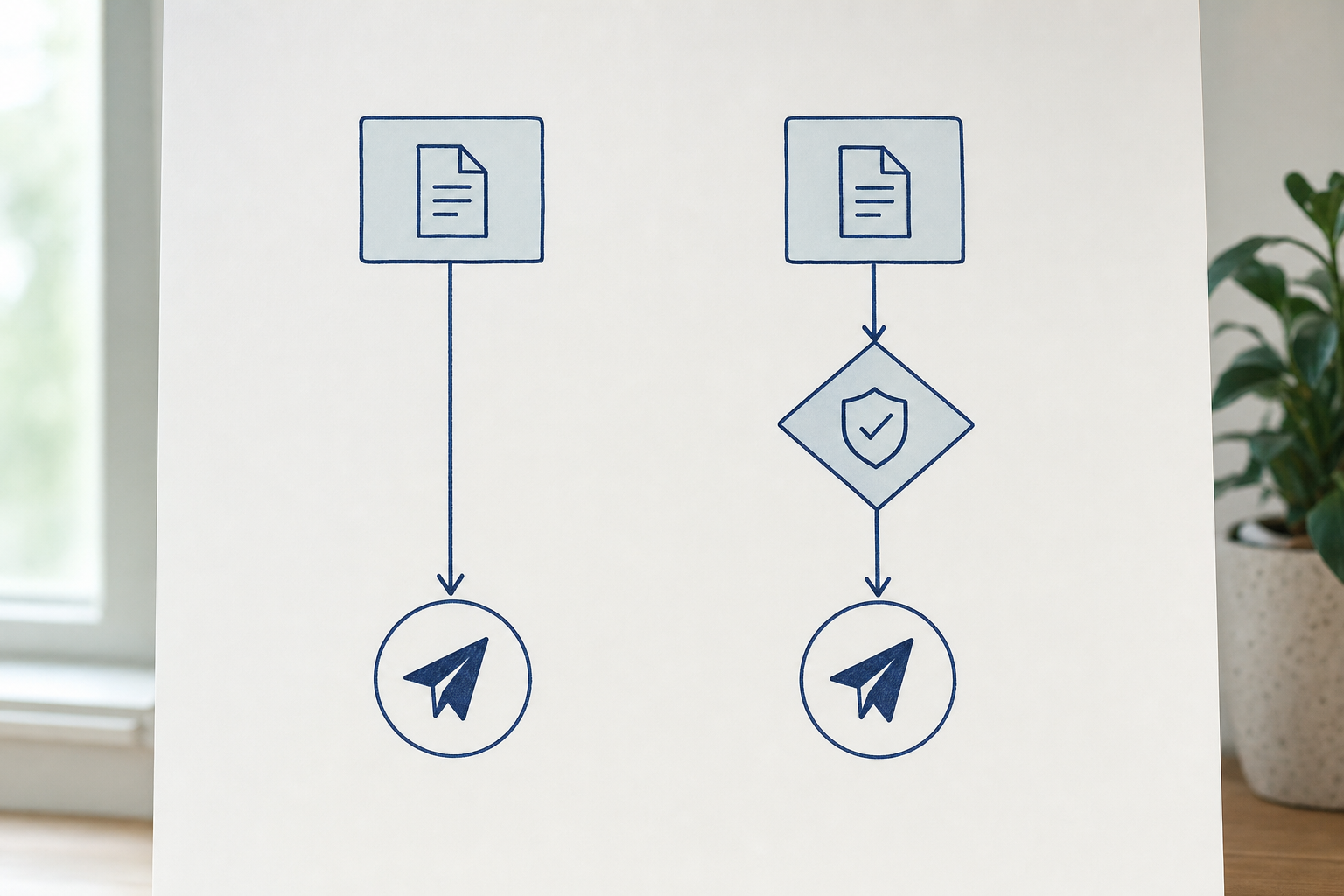
There is a specific point in the AI content process where AI slop either gets prevented or gets published. It sits between the model output and the publish button.
A real AI content workflow has four steps: trigger → input source → AI model → editorial pass → destination output. The critical gate is the editorial step before publication. Any process that lets model output go directly to the publish button isn't a workflow. It's an output pipe. And output pipes are where AI slop comes from.
The editorial pass doesn't need to be long. In a well-configured workflow with a brand voice profile loaded, review runs 10–15 minutes per piece. What it catches: the opener the model defaults to when it has no stronger signal, the claim that needs a specific number rather than a vague one, the sentence structures the model reaches for when it runs out of directed context.
The time-savings figure cited most often, 3.8 hours of manual work compressed to around 9.5 minutes, is real but conditional. It assumes the workflow includes a structured brief, a brand voice profile, and a review pass. Without the review, that figure is the speed of an output pipe, not the speed of a workflow. And the output reflects the difference.
The brand voice profile is what gives the editorial pass something to check against. A one-time setup of around four hours builds a profile of how the brand actually writes: register, vocabulary, ICP assumptions, examples of content that already sounds right. With that loaded, the model works within the brand's patterns rather than reaching for its defaults. Without it, the model produces its defaults, the pass has nothing to check against, and the output reads like everyone else's.
What Google actually penalises
Worth addressing directly, because it comes up in every content conversation: Google does not penalise AI authorship. Its "scaled content abuse" policy, active since June 2025 and enforced visibly in the March 2026 core update, targets mass-produced AI pages published without editorial oversight or unique value. Sites publishing hundreds or thousands of unreviewed AI pages saw 50–80% traffic drops in the March 2026 update, not because they used AI, but because they published unreviewed batch output at volume.
An Ahrefs study of 600,000 pages found 86.5% of top-ranking pages already use some AI assistance, with near-zero correlation between AI use and ranking penalties. The question Google is asking is the same question your readers are asking: did a person actually engage with this content before it went live?
The editorial pass answers both. The step that prevents AI slop is the same step that keeps you clear of Google's enforcement.
Why a workflow prevents AI slop when a tool stack doesn't
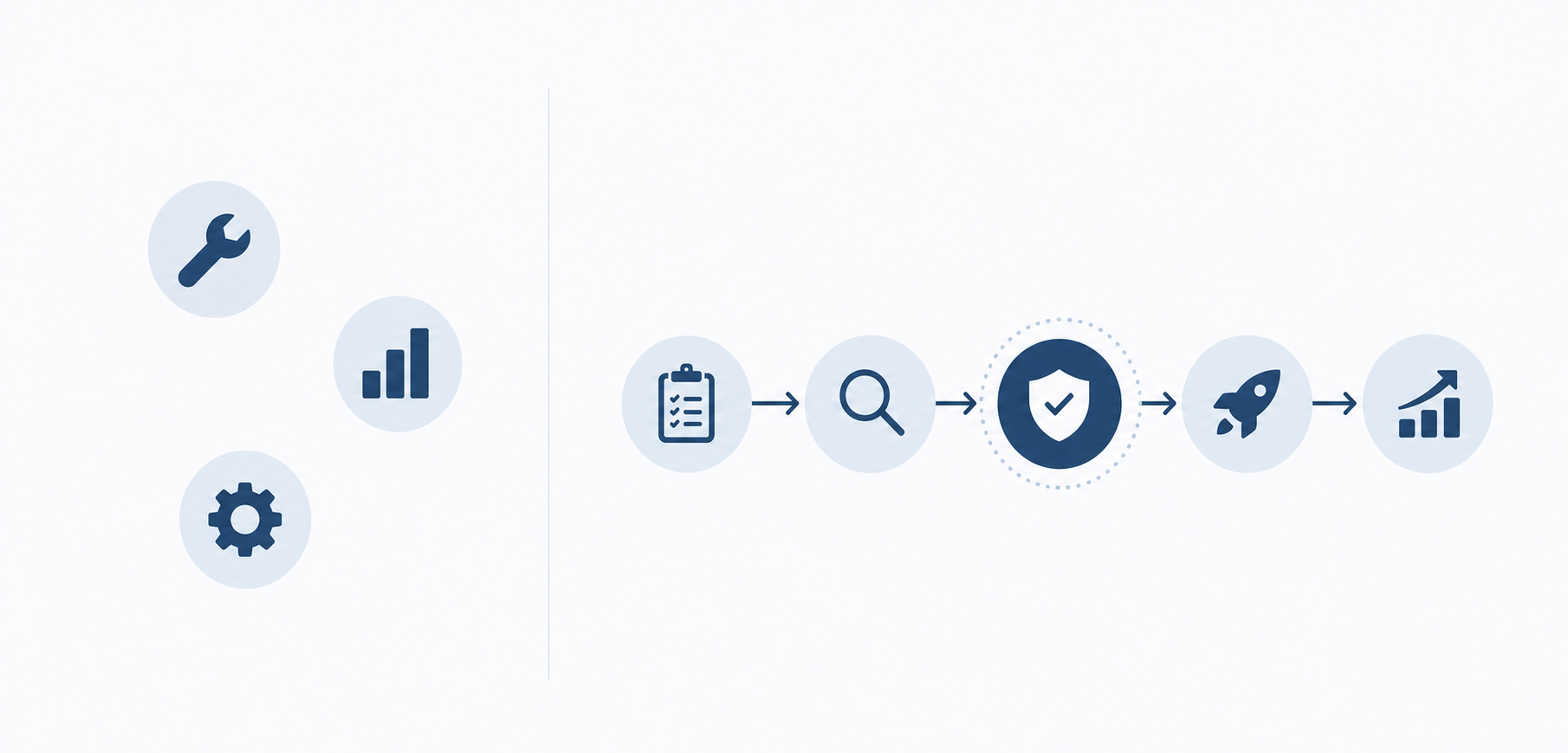
The gap between "using AI tools" and "running an AI content workflow" is where most AI slop originates.
A stack of disconnected tools produces different outputs depending on which tool you used, which prompt you wrote, and whether you checked the voice before publishing. A workflow runs the same steps (brief, brand voice profile, draft, editorial pass) in the same order, every time. The consistency is what produces consistent output. One-off prompts produce one-off outputs.
Tool consolidation matters here too. Three disconnected AI tools with three different prompt patterns produce three different voice outputs in the same week. Standardising on a small set of tools and documenting exactly how the team uses them, one workflow not one prompt per post, is what turns AI tools into an AI content workflow.
The volume promise of AI content is real: a structured workflow compresses production time significantly. But it only holds when the editorial pass is non-negotiable, not a best practice added when there's time. The pass is what separates fast, publishable output from fast output that damages brand trust before anyone catches it.
What this looks like in practice
Avoiding AI slop is a process architecture question, not a writing skill. The workflow that produces content that reads like you:
- Loads your voice before drafting. Every run starts with a brand voice profile, not a generic instruction: a documented profile of how the brand actually writes and what it avoids.
- Sources claims from a research brief, not model recall. Specific numbers cited from real sources are what separate substantive content from padded output. A model left to its own recall produces generalisations; a brief produces citations.
- Runs an editorial pass before publishing. Not proofreading. A pass that targets the patterns that signal "unreviewed AI output": model-default openers, vague claims, sentence structures the model reaches for when context runs thin.
- Runs the same sequence every time. Consistency is what makes the voice recognisable across pieces. Anything ad hoc in the process produces ad hoc output.
The content that gets read, shared, and cited sounds like a person with specific knowledge, not a tool with fast output. The workflow is how you produce that at speed, and for more on how the same workflow scales across multiple clients, see The AI content workflow for small marketing agencies.
Sources
- [S1] B2B Content Marketing Report 2026, Content Marketing Institute, fielded Jun–Aug 2025, N>1,000 B2B marketers
- [S2] Does Google Ignore AI Content? What the Data Says, Snezzi (citing Ahrefs N=600,000 study), 2026
- [S4] Best Content Marketing Workflow for Seed-Stage SaaS Startups, Averi, 2026
- [S5] The AI-Assisted Content Workflow for Founders (2026 Hybrid Model), Foundera, 2026
- [S8] Why AI-Driven Creative Is Failing and How to Fix It, MarTech, 2025
- [S9] Why AI-Generated Holiday Ads Fail, Nielsen Norman Group, 2025
- [S10] FAQ on Content Marketing: AI Saturation, Zero-Click Search, What's Still Working in 2026, eMarketer, 2026
- [S11] Scaled Content Abuse: Google's AI Page Crackdown Guide, Digital Applied, 2026
- [S12] AI Content Creation Workflows: Scale Quality Content, NAV43, 2026
FAQ
What is AI slop?
AI slop is content produced by AI tools without a human review pass: generic, pattern-matched output that reads as model-generated rather than person-authored. The term was named Merriam-Webster's 2025 word of the year. The defining characteristic is not that it was AI-written; it's that nobody read it before it was published.
Does using AI for content always produce AI slop?
No. 86.5% of top-ranking web pages already use some AI assistance, with near-zero correlation to quality or ranking penalties. The variable is whether the process includes a brand voice profile and an editorial review pass. Without those, the output defaults to the model's generic patterns. With them, the output sounds like the brand.
How do you make AI content sound human?
Three things: a brand voice profile loaded before drafting (so the model works within your patterns, not its defaults), a research brief with specific sourced claims (so the content is substantive, not padded), and an editorial review pass before publishing (so you catch the generic phrases, weak openers, and vague claims the model defaults to). The result reads like you had a productive day, not like a tool ran overnight.
What does Google penalise: AI content or AI slop?
Google's scaled content abuse policy targets mass-produced AI pages published without editorial oversight, not authorship. 86.5% of top-ranking pages use AI assistance. The editorial pass protects both SEO and content quality: it's the step that demonstrates a person engaged with the content before it went live.
How long does the editorial review pass actually take?
In a well-configured workflow with a brand voice profile, the review runs 10–15 minutes per piece. The goal is not proofreading. It's catching the specific patterns that signal unreviewed AI output: model-default openers, vague claims, uniform sentence structures, absent specificity. That pass is what converts a fast draft into content worth publishing.
The process, ready to run
If you want the workflow described here packaged and ready to run (voice profile setup, brief structure, draft and atomization, editorial pass), that's what we built at VibeMyWay. The On-Voice Content Process guide walks through the exact steps. For the full system, see vibemyway.com.
Made with vibemyway.com
Created with VibeMyWay MarketingKit. Reviewed and approved by VibeMyWay before publishing.